Your technology stack was built for a different era. Your business has outgrown it.
That ERP customization from 2014. The monolithic application held together by tribal knowledge. The three databases that should be one. Caxy's technology strategy practice helps CIOs and CTOs modernize without the risk of rip-and-replace. We assess what you have, design where you need to go, and build the bridge between the two - one phase at a time.
Your technology decisions are constrained by your technology debt.
You can't adopt AI because your data is trapped in silos. You can't launch a customer portal because your backend wasn't built for external access. You can't hire top engineers because nobody wants to maintain a 15-year-old codebase. Technical debt doesn't just slow down development - it limits what your business can even attempt. Caxy works with CIOs and CTOs to untangle decades of accumulated technology decisions and create a modernization path that delivers value in phases. We don't ask you to shut down for 18 months while we rebuild everything. We identify the highest-leverage changes, execute them first, and use early wins to build organizational momentum for the broader transformation.
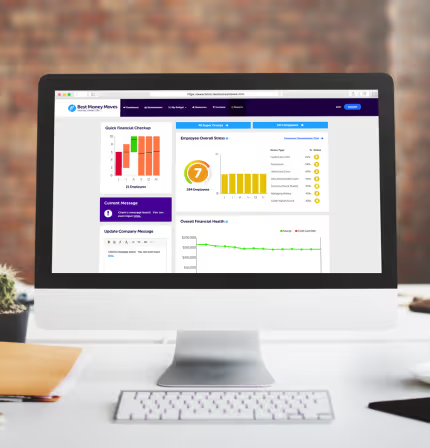















We map your entire technology landscape before recommending a single change.
Our technology assessments go deeper than a vendor evaluation or architecture diagram review. We interview engineering teams, analyze codebases, audit infrastructure costs, map data flows, and benchmark your stack against industry standards. The output is a scored assessment across eight dimensions - scalability, security, maintainability, cost efficiency, developer experience, data architecture, integration capability, and operational resilience. Each dimension receives a current-state score, target-state score, and a specific set of initiatives to close the gap. This becomes the foundation for a multi-year modernization roadmap with realistic timelines, cost estimates, and risk mitigation strategies for each phase.



Rip-and-replace modernization fails more often than it succeeds. It takes too long, costs too much, and forces the business to run two systems in parallel. Caxy uses incremental modernization strategies - strangler fig patterns, API facades, event-driven decoupling - that let you replace components one at a time while the existing system continues to operate. We've migrated monolithic applications to microservices, on-premise infrastructure to AWS, and legacy databases to modern data platforms without a single day of downtime. The key is sequencing: each migration phase delivers standalone value and reduces risk for the next phase.
Moving to the cloud isn't a strategy - it's an implementation detail. The strategy is designing an architecture that gives your business the flexibility to integrate, scale, and adapt without rebuilding. Caxy designs API-first architectures where every capability is accessible as a service - to your internal teams, your partners, and your customers. As an AWS Advanced Consulting Partner, we bring certified architects who have designed and deployed cloud infrastructure for over 100 production platforms. We handle migration planning, infrastructure-as-code, CI/CD pipelines, security hardening, and cost optimization so your team can focus on building the products that drive revenue.
Technology Strategy questions
Technology strategy consulting is the practice of aligning an organization's technology investments, architecture, and team capabilities with its business objectives. It covers technology assessment, architecture design, build-vs-buy-vs-integrate decisions, vendor evaluation, cloud strategy, and multi-year roadmap development. The goal is maximizing ROI on technology spending while reducing operational risk and technical debt.
Incremental modernization uses patterns like the strangler fig - wrapping legacy components with modern APIs so they can be replaced one at a time while the overall system continues operating. Each phase delivers standalone value. Combined with feature flags and parallel-run testing, this approach eliminates the need for big-bang cutovers that put the business at risk. Typical migrations take 6 to 18 months across phases.
A cloud migration strategy defines which workloads move to the cloud, in what order, and using which migration pattern - rehost (lift and shift), replatform, refactor, or rebuild. It includes cost modeling, security and compliance review, network architecture, data migration planning, and a rollback plan for each phase. Organizations with 50+ servers typically take 12 to 24 months for full migration.
API-first architecture means designing every system capability as an accessible, documented API before building user interfaces or integrations. This approach enables faster partner integrations, mobile app development, and third-party extensions without modifying core systems. Companies with API-first architectures launch new channels 3-4x faster because the backend is already designed for external access.
IT modernization for companies with $50M to $500M in revenue typically costs between $500K and $3M over 2 to 3 years, phased into quarterly or semi-annual releases. Individual phases range from $100K to $500K. Caxy's Game Changer Assessment at $50K provides the detailed roadmap and cost estimates needed to budget accurately before committing to the full program.
Prioritize by business risk and maintenance cost. Systems with single points of failure, no vendor support, or annual maintenance exceeding 40% of replacement cost should move first. Map dependencies to identify which modernizations unblock the most downstream improvements. Start with systems that have clean data boundaries - they're easiest to decouple and deliver the fastest proof points for stakeholder buy-in.
Our assessment evaluates eight dimensions: scalability, security, maintainability, cost efficiency, developer experience, data architecture, integration capability, and operational resilience. We conduct codebase analysis, infrastructure audits, team interviews, and data flow mapping. Deliverables include a scored current-state assessment, gap analysis, and a phased modernization roadmap with cost estimates and risk mitigation plans.



.avif)