Your player data is your most valuable asset. Most of it is trapped in systems that cannot talk to each other.
Casino management systems were built for regulatory compliance, not marketing intelligence. Your player data sits in SYNKROS or OASIS, your hotel data in Opera, your dining data in a separate POS, and your loyalty program in yet another system. Meanwhile, sports betting apps have trained your guests to expect everything from their phone. The operators winning right now are the ones connecting all of it.
You have more player data than any of your competitors. You just cannot use it.
Your CMS tracks every pull, every bet, every rated session. Your PMS knows every room preference, every comp, every special request. Your POS has dining history, spending patterns, and visit frequency. Your loyalty program has point balances, tier status, and redemption behavior. But none of these systems share data in real time. Your hosts make decisions based on yesterday's reports. Your marketing sends the same offer to every player in a tier. Your app - if you have one - shows a static list of promotions that has nothing to do with the guest standing in your lobby right now. Your competitors with unified player profiles are delivering personalized experiences at every touchpoint. The data gap is becoming a revenue gap.
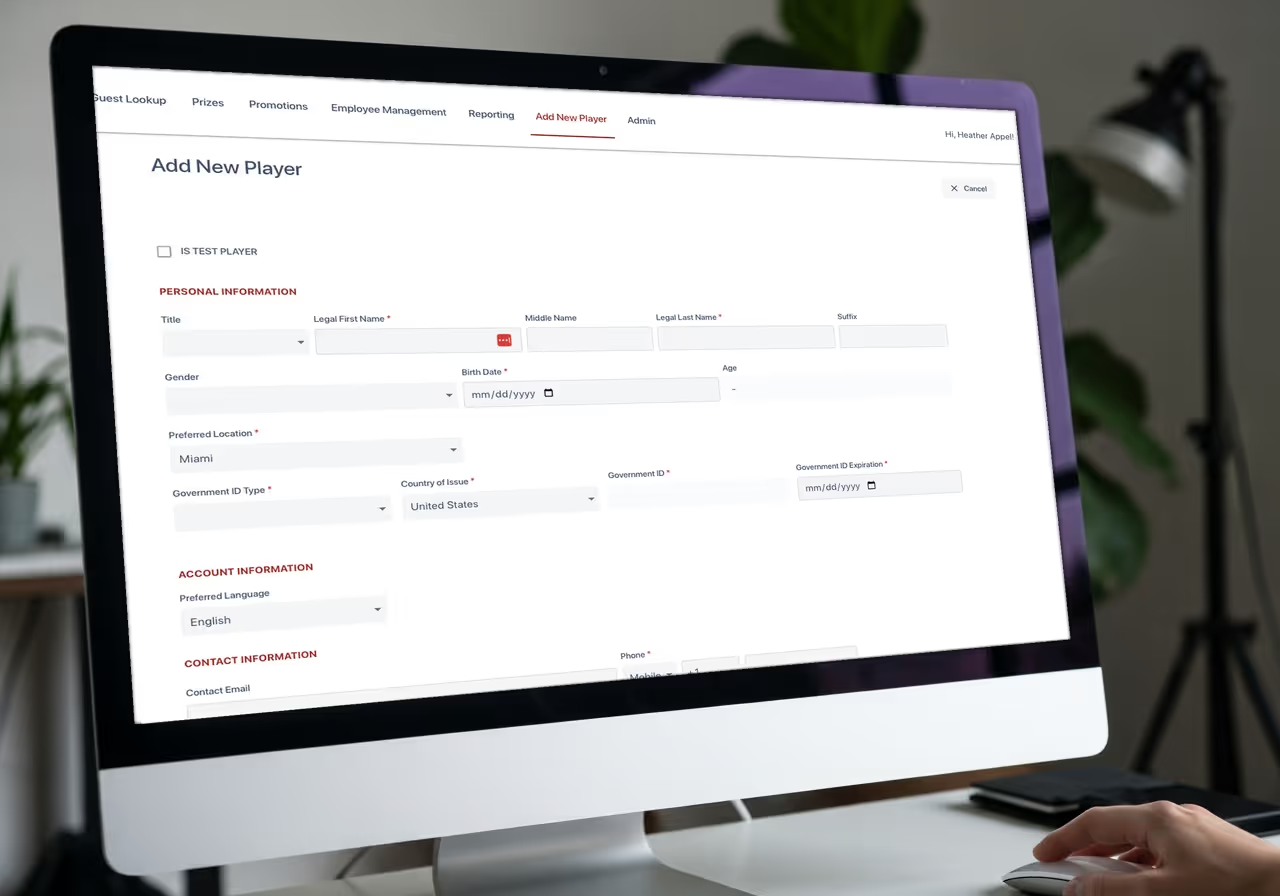
















How Caxy built the digital platform for one of the largest tribal gaming enterprises in the country.
Wind Creek Hospitality, owned and operated by the Poarch Band of Creek Indians, operates casinos and resorts across multiple states. Caxy led the digital transformation - designing and building mobile applications, player loyalty systems, and integrated digital platforms that unified the guest experience across properties. The engagement required deep understanding of tribal governance, MICS compliance, NIGC regulations, and data sovereignty requirements. Our engineers built platforms that handle real-time player data, property management integration, and multi-property loyalty programs - all with US-only teams and full tribal data sovereignty. The CTO called us "the smartest group of people I've worked with."



AI is transforming gaming from reactive marketing to predictive guest experience. Player segmentation models identify high-value players before they self-identify, enabling targeted offers.Churn prediction models flag at-risk players 30-60 days before they stop visiting. Dynamic offer optimization tests thousands of promotion variants and converges on the highest-ROI combinations. Real-time personalization delivers different experiences to different player tiers across mobile, on-property signage, and host communications. Caxy built an AI-powered ticket validation system for a State Lottery Commission using Google Vision AI - achieving 99.2% accuracy, 90% reduction in validation time, and $2.3M in annual savings. We bring this same AI discipline to gaming operations.
Tribal gaming operations have unique requirements that most software firms do not understand. MICS compliance requires detailed transaction logs, separation of duties, independent audit access, and specific data retention. NIGC regulations add federal oversight layers. Data sovereignty means tribal data must be stored and processed under tribal authority - not in a vendor's multi-tenant cloud. Caxy's entirely US-based engineering team builds compliant architecture from the foundation. We do not retrofit compliance onto existing platforms. We architect for it from day one. Every system we build for tribal gaming includes audit trails, role-based access controls, and data residency controls that meet or exceed regulatory requirements.
What gaming and hospitality operators need to know about custom software
A unified player profile combines data from your CMS, PMS, POS, loyalty program, and mobile app into a single real-time view of each guest. It enables personalized offers, predictive host assignments, and cross-property recognition. Casinos with unified profiles see 15-25% increases in visit frequency and 20-30% improvements in marketing ROI because offers are based on complete behavior, not single-system snapshots.
AI player segmentation analyzes betting patterns, visit frequency, spending across amenities, response to past offers, and demographic data to create dynamic micro-segments. Unlike static tier-based systems, AI segments update in real time as player behavior changes. This enables marketing to send the right offer to the right player at the right moment - before they churn, after a big win, or when visit frequency drops.
Minimum Internal Control Standards require gaming software to maintain detailed transaction logs, enforce separation of duties, support independent audit access, and meet specific data retention requirements. NIGC regulations add federal oversight layers including reporting requirements. Custom software must build audit trails, role-based access controls, and tamper-evident logging into the core architecture - not as afterthoughts.
Data sovereignty means tribal data is stored, processed, and governed under tribal authority rather than a third-party vendor's terms. For tribal gaming operations, this requires US-based hosting with specific access controls, tribal-owned encryption keys, and contractual guarantees that data cannot be accessed by non-authorized parties. It is both a regulatory requirement and a sovereignty principle.
Custom gaming platforms range from $200K for focused applications like a player-facing mobile app to $2M+ for comprehensive platforms covering CMS integration, loyalty, mobile, and analytics. A unified player data warehouse with marketing automation typically runs $500K-$1M. The ROI calculation should include increased visit frequency, higher marketing ROI from personalization, and reduced churn.
Yes. Caxy has direct experience integrating with IGT Advantage, Aristocrat OASIS, Light & Wonder systems and others. We build middleware layers that extract player data in real time without disrupting CMS operations. These integrations feed unified player profiles, analytics dashboards, and marketing automation platforms while maintaining full audit compliance.
Caxy built Wind Creek Hospitality's digital platform with full understanding of tribal governance, MICS compliance, and data sovereignty requirements. Every engineer on tribal projects is US-based. We respect sovereignty - we are technology partners, not consultants telling tribes how to run their operations. Our architecture decisions prioritize tribal data ownership, regulatory compliance, and long-term independence from any vendor.
A gaming mobile app with basic CMS integration takes 4-6 months. A unified player data platform with analytics and marketing automation takes 8-14 months. Full digital transformation across mobile, loyalty, personalization, and cross-property integration takes 12-24 months in phased releases. Caxy runs 2-week sprints with working demos so operators see progress every 14 days.





.avif)