You built a great business. Now turn what your team knows into a SaaS product - with you as the first customer.
The hardest part of building a SaaS company is not the software. It is knowing what to build, who to sell it to, and which version of your idea will actually scale. You already have that knowledge - it lives in your service team's heads, your customer support tickets, and the spreadsheet workflows you have refined over a decade. The question is whether you can productize it before a venture-backed competitor does.
Your normal growth is linear. SaaS revenue compounds. The gap between the two is engineering you do not have.
Most companies that try to build a SaaS product fail in the same way. They hire one developer who builds the wrong thing for nine months. Or they outsource to an offshore team that ships something technically working but commercially dead. Or they buy a no-code tool that hits a wall the moment a real customer asks for an integration. The pattern is not a technology problem - it is a product problem. You need someone who can translate domain expertise into a shippable v1, validate it with paying customers in 90 days, and architect it so the platform scales when growth hits. That requires senior engineers who have done this before, a product process that kills bad ideas fast, and the discipline to ship a small thing that works rather than a large thing that does not. This is what we have done for 25 years and 100+ platforms.
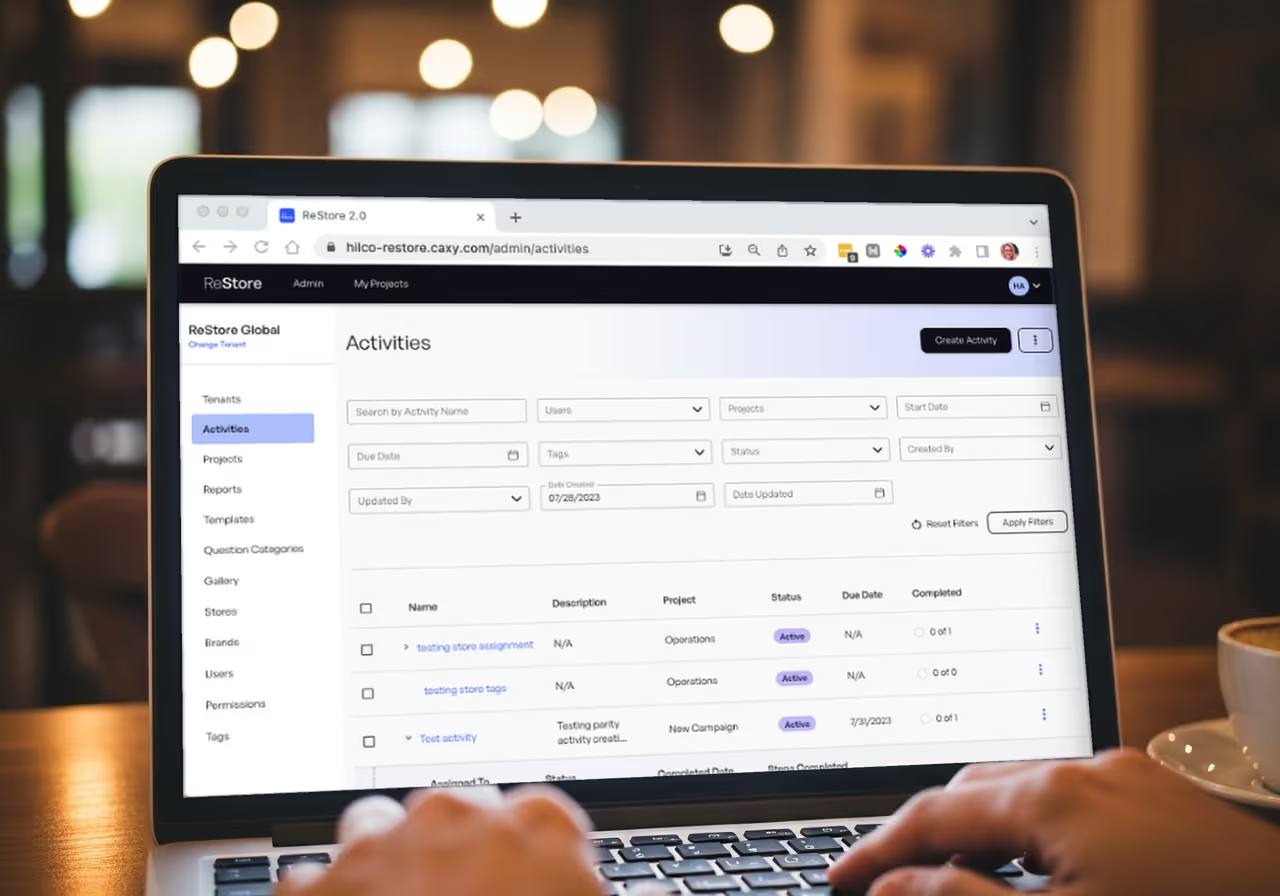















From startup to $1B+ exit. Caxy has built the platforms that power financial services at scale.
Caxy built much of the customer experience for tastylive and tasty trade from startup through explosive growth to a $1 billion acquisition by IG Group. We engineered real-time video streaming, options analytics, and trading interfaces for one of the most innovative fintech platforms in the industry. We rebuilt tastylive's financial media network. We designed and built Harbor Capital Advisors' investment site from the ground up - real-time fund data, interactive charts, and a Contentstack CMS that lets their team manage content without touching code. We built Best Money Moves' AI-powered financial wellness platform, including RAG-based knowledge systems, and ML chatbots. Every one of these platforms handles sensitive financial data under strict compliance requirements. SOC 2, FFIEC, GDPR - compliance is not an add-on for us. It is how we build.



3 ways to work

Build Your First SaaS
For non-technical founders with a real problem and no engineering team. You spent 15 years in your industry. You see the workflow gap nobody is fixing. You do not need another developer who will build whatever you ask for - you need a partner who will pressure-test the idea, scope a v1 that you can actually sell, and ship it in 12 weeks so you can land your first 10 paying customers.
Productize Your Services
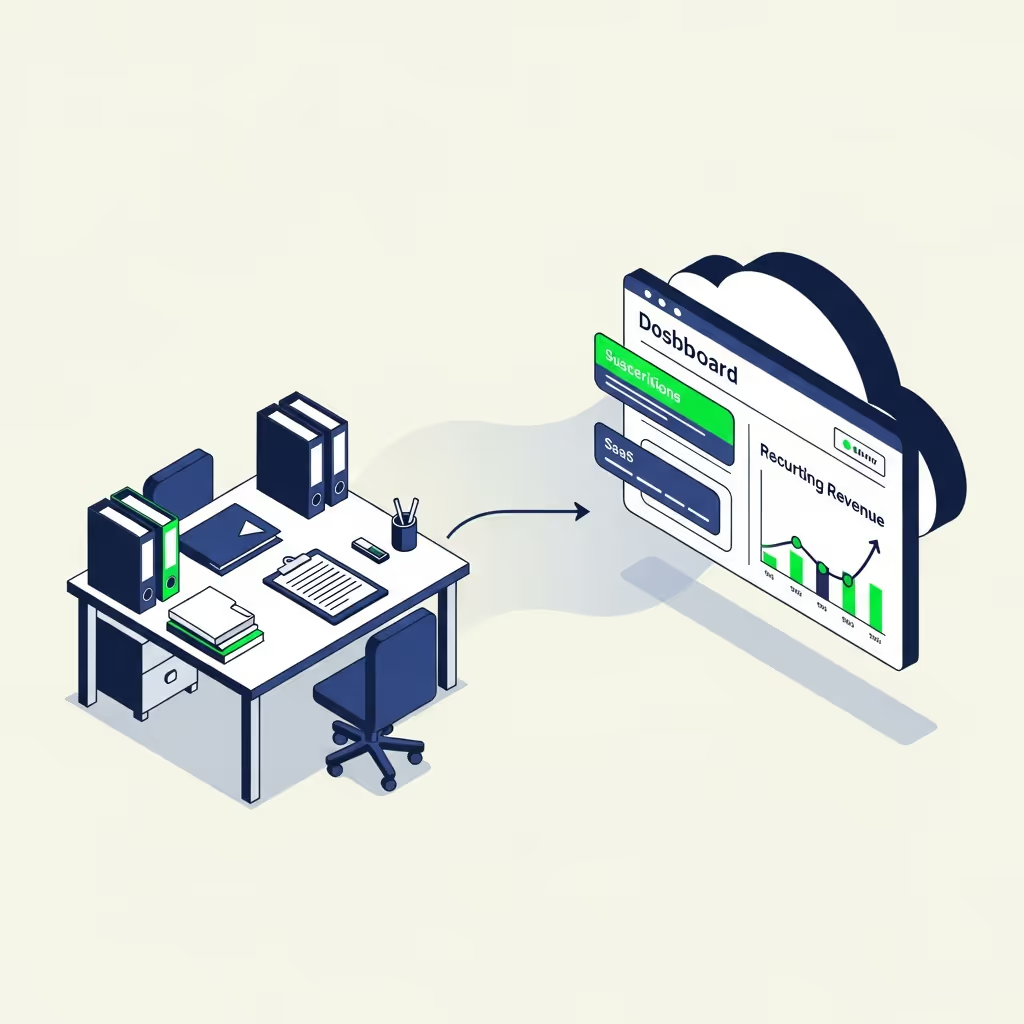
For established companies turning service expertise into recurring revenue. Your services business has the domain expertise, the customer relationships, and the proof that the problem is real. We help you extract the repeatable workflow, build a minimum lovable product, and validate pricing with your existing customers before you spend $500K on engineering.
Heading
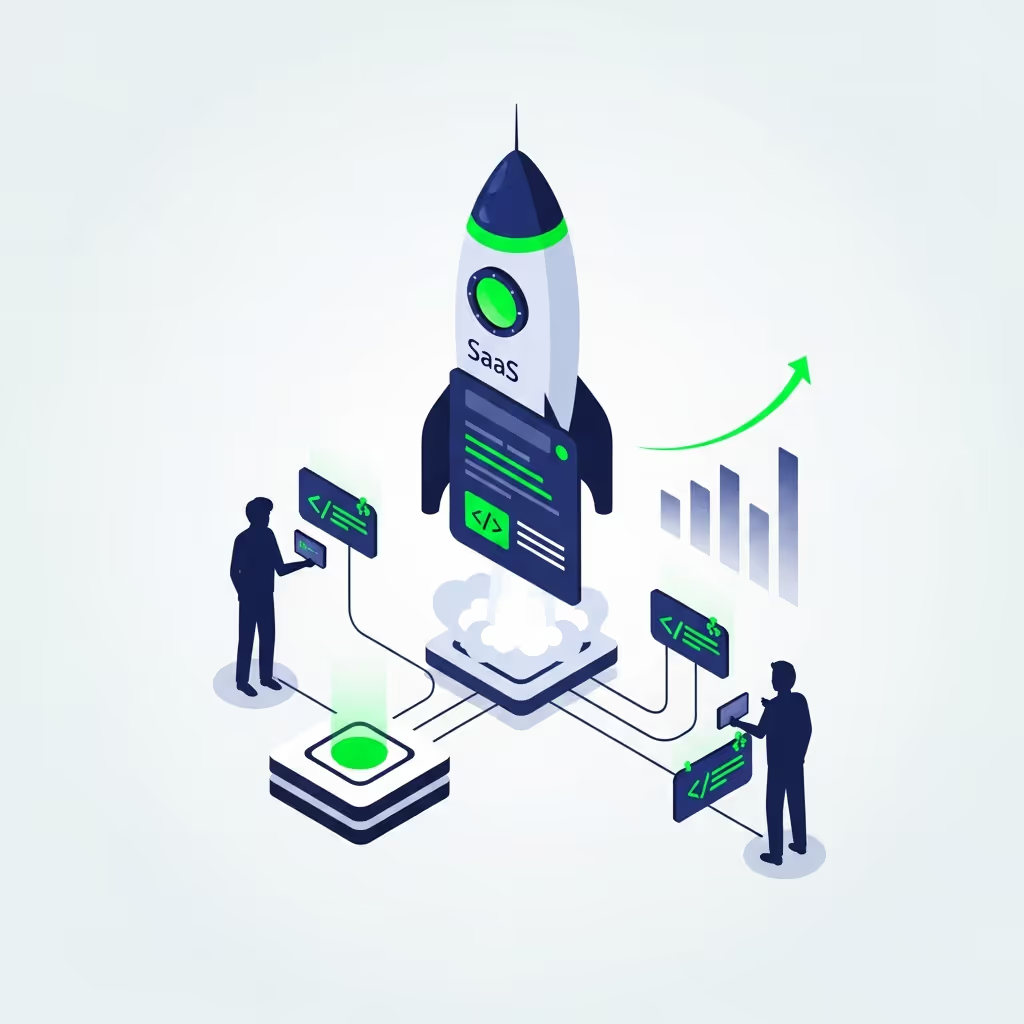
For Series A and B SaaS teams that need senior capacity fast. You raised your A. You have product-market fit signals. Now you need to ship 3x faster without hiring 10 engineers and spending 18 months on team culture. We embed a senior team of architects and engineers who match your sprint cadence, submit PRs to your repo, and ship production code from week three
AI in financial services has the highest regulatory stakes and some of the highest ROI. Fraud detection models reduce false positives by 50-70% compared to rules-based systems. AI-assisted document processing cuts loan origination time from days to hours. Member onboarding powered by AI reduces abandonment by pre-filling forms, verifying identity in real time, and personalizing the experience. Caxy built Best Money Moves' AI platform with retrieval-augmented generation, achieving a 40% increase in user engagement and 70% reduction in customer service tickets. Every AI decision in financial services must be auditable, transparent, and compliant with FFIEC, NCUA, and OCC guidance - which is why off-the-shelf AI tools fail here and custom implementations succeed.
Most firms start a SaaS build with a sprint plan. We start with three questions: who is the first paying customer, what is the smallest version of the product they will pay for, and what is the architecture that will not need to be rewritten when you hit 1,000 of them. The first 30 days are discovery and MVP scoping - interviewing your users, mapping the workflow, killing the features that do not earn their place. The next 90 days ship the v1. Two-week sprints, working demos every cycle, real users testing every release. By month four you have paying customers and a roadmap informed by their behavior, not your assumptions. This is how we shipped tastytrade from startup to acquisition, Best Money Moves to $11M+ in funding, and ICC's CDP from internal tool to platform. The pattern is consistent. The discipline is what is rare.
AI in financial services has the highest regulatory stakes and some of the highest ROI. Fraud detection models reduce false positives by 50-70% compared to rules-based systems. AI-assisted document processing cuts loan origination time from days to hours. Member onboarding powered by AI reduces abandonment by pre-filling forms, verifying identity in real time, and personalizing the experience. Caxy built Best Money Moves' AI platform with retrieval-augmented generation, achieving a 40% increase in user engagement and 70% reduction in customer service tickets. Every AI decision in financial services must be auditable, transparent, and compliant with FFIEC, NCUA, and OCC guidance - which is why off-the-shelf AI tools fail here and custom implementations succeed.
What financial services companies need to know about custom software
A full v1 SaaS product typically runs $250K-$750K depending on scope. A focused MVP with one core workflow ships for $150K-$300K. A platform with multi-tenant architecture, AI features, and integrations runs $500K-$1M+. The variable that drives cost most is not the technology - it is how many features you insist on shipping in v1. Caxy's product process kills 60-80% of the features founders initially want, which is why our SaaS builds ship in 12-16 weeks while most firms take 9 months.
A focused MVP can be live with paying customers in 12-16 weeks. The first 30 days are discovery - identifying the smallest version of the product someone will actually pay for. The next 8-12 weeks are 2-week sprints, with a working demo at the end of each one. Most "MVPs" fail because they are not minimum and not viable - they try to be a full product without enough customer signal. Our MVP scope process cuts the feature list down to what 10 paying customers will actually use.
Yes - and the path is more predictable than founders think. Companies with established services revenue have three advantages venture-backed startups do not: domain expertise that took years to build, existing customers who can test and validate the product, and revenue that funds the build without diluting equity. The productization process identifies the 20% of your service that 80% of customers will pay a recurring subscription for, builds that as a v1, and validates pricing with your existing customer base. This is how we have helped service companies in education, financial wellness, and hospitality launch SaaS products without abandoning their core business.
Yes - 100% IP and source code ownership from day one. No licensing fees, no proprietary frameworks, no platform lock-in. We build on open-source technologies and standard cloud infrastructure (AWS, React, Node.js, Python) specifically so you are never dependent on us. Your codebase, your IP, your customer data, your AWS account. Most clients stay because we deliver value over multi-year engagements - not because they are stuck.
No. Most successful non-technical SaaS founders engage a senior product partner instead of hiring a CTO in year one. A CTO at a pre-revenue startup costs $200K-$350K plus equity and 6+ months to recruit. A product partner like Caxy delivers senior architecture decisions, builds the v1, and helps you hire your first technical employee at the right time - typically after you have product-market fit signals and 10+ paying customers. The wrong CTO hire too early can sink the company. The right product partnership reduces that risk.
Three differences that matter: senior US engineers with 5+ year average tenure (versus offshore teams where the engineer building your v1 has 18 months experience and rotates off in 6 months), direct communication with the engineers writing your code (no account managers translating requirements through three time zones), and a product process that pressure-tests your idea before writing code. Offshore rates look 60% cheaper per hour but typical projects run 2-3x over scope because of communication gaps and rework cycles. The total cost converges. The product quality does not.
Our core SaaS stack is React, Next.js, Node.js, Python, TypeScript, and PostgreSQL on AWS. Mobile is React Native or Swift. AI features use Claude, OpenAI, custom models, and RAG systems with Pinecone or Weaviate. Infrastructure runs on AWS with Terraform, Docker, Kubernetes, and CI/CD pipelines. We are an AWS Advanced Partner with 9 certifications. We build on industry-standard technologies specifically so your future engineering team can hire from a large talent pool and so your platform is not locked into proprietary frameworks.
Validation happens in the first 30 days, before significant engineering investment. We interview 8-15 potential customers, map their existing workflow and willingness to pay, identify the specific feature that triggers a purchase decision, and pressure-test pricing with real conversations - not surveys. The output is a validated MVP scope, a confidence score on customer willingness to pay, and a clear "build" or "don't build" recommendation. About 1 in 4 ideas that reach us do not pass validation. Telling a founder "do not build this" has saved clients $500K+ on multiple occasions.


.avif)