Your members expect a fintech experience. Your core system was not built to deliver one.
Community banks and credit unions are losing the under-35 demographic to Chime, SoFi, and Robinhood - not because fintechs offer better rates, but because they offer better experiences. Digital account opening that takes 3 minutes instead of 30. Mobile apps rated 4.6 stars instead of 3.2. Real-time everything instead of batch processing. The gap is not about budget. It is about architecture.
Your 3.2-star app is competing against 4.6-star fintech experiences. The math does not work.
Digital account opening abandonment sits above 60% at most community institutions. Members under 35 are defecting at twice the rate of older demographics. Your mobile app asks users to do things that no fintech would dream of - visit a branch, mail a form, call during business hours. Your core banking system - Jack Henry, Fiserv, FIS - was built for stability and compliance, not for the kind of real-time, personalized experiences your members now expect from every financial app on their phone. The regulators are asking harder questions about AI governance, third-party risk management, and data privacy. And your board just saw a headline about another community bank that got acquired because they could not keep up. This is not a technology problem you can solve with another vendor module. It requires custom software that connects your core system to modern experiences without replacing it.
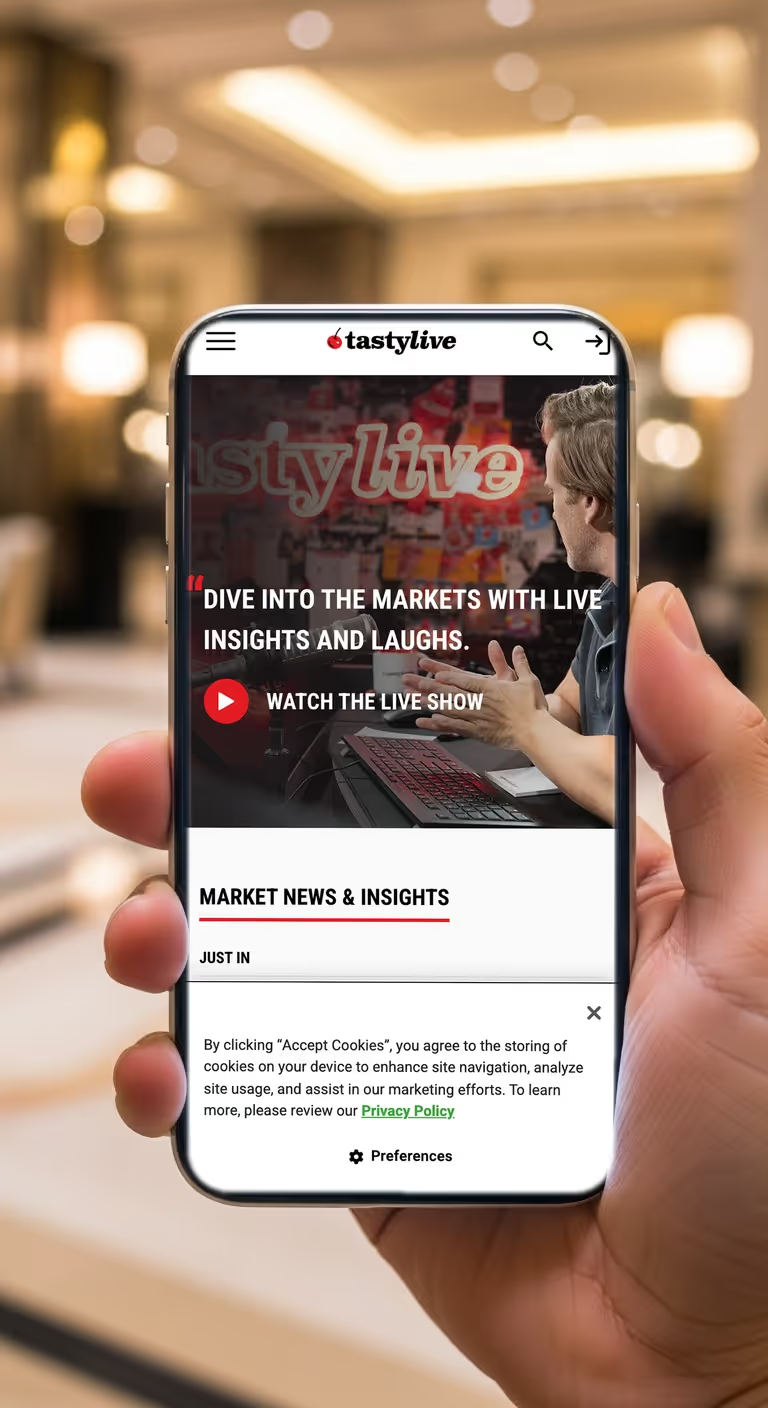
















From startup to $1B+ exit. Caxy has built the platforms that power financial services at scale.
Caxy built much of the customer experience for tastylive and tasty trade from startup through explosive growth to a $1 billion acquisition by IG Group. We engineered real-time video streaming, options analytics, and trading interfaces for one of the most innovative fintech platforms in the industry. We rebuilt tastylive's financial media network. We designed and built Harbor Capital Advisors' investment site from the ground up - real-time fund data, interactive charts, and a Contentstack CMS that lets their team manage content without touching code. We built Best Money Moves' AI-powered financial wellness platform, including RAG-based knowledge systems, ML chatbots, and serverless portfolio analysis that achieved $3.50 ROI per dollar spent. Every one of these platforms handles sensitive financial data under strict compliance requirements. SOC 2, FFIEC, GDPR - compliance is not an add-on for us. It is how we build.



AI in financial services has the highest regulatory stakes and some of the highest ROI. Fraud detection models reduce false positives by 50-70% compared to rules-based systems. AI-assisted document processing cuts loan origination time from days to hours. Member onboarding powered by AI reduces abandonment by pre-filling forms, verifying identity in real time, and personalizing the experience. Caxy built Best Money Moves' AI platform with retrieval-augmented generation, achieving a 40% increase in user engagement and 70% reduction in customer service tickets. Every AI decision in financial services must be auditable, transparent, and compliant with FFIEC, NCUA, and OCC guidance - which is why off-the-shelf AI tools fail here and custom implementations succeed.
We do not rip and replace your core banking system. We build the modern software layer on top of it. Your Jack Henry SilverLake, Symitar, Fiserv DNA, or FIS IBS holds decades of member data, compliance logic, and transaction history. Custom middleware connects that data to modern applications - mobile banking, digital account opening, member portals, AI-powered analytics - without disrupting your system of record. Caxy has 25 years of enterprise integration experience, including complex financial systems, real-time data feeds, and regulatory reporting. We understand the difference between a credit union and a bank. We say "member" not "customer." And we build platforms that pass NCUA examination, not just QA testing.
What financial services companies need to know about custom software
Custom financial services software ranges from $150K for a focused digital account opening application to $1M+ for a comprehensive member experience platform. Mobile banking app development runs $300K-$600K. The ROI calculation should include member acquisition cost reduction, deposit growth from improved digital onboarding, and operational savings from reduced branch transactions.
Digital account opening replaces branch-based enrollment with a fully online process - identity verification, funding, and account activation completed in 3-5 minutes from a phone. Community banks with modern digital onboarding see abandonment rates drop from 60%+ to under 20%. The technology combines document scanning, real-time KYC verification, and e-signature to eliminate the friction that drives members to fintechs.
Build middleware layers that connect to Jack Henry SilverLake, Symitar, Fiserv DNA, and Fiserv Precision through their published APIs and real-time data interfaces. The integration layer translates data formats, handles error recovery, and maintains synchronization between your core and modern applications. This approach keeps your core system as the system of record while enabling modern member-facing experiences.
AI helps community institutions close the experience gap in three areas: personalization (tailored product recommendations based on member behavior), automation (document processing, loan decisioning, compliance monitoring), and prediction (churn prevention, cross-sell scoring, fraud detection). The key requirement is explainability - every AI decision must be auditable. Caxy builds AI with human-in-the-loop safeguards that satisfy regulatory scrutiny.
SOC 2 compliance is built into our engineering process from sprint one. We implement access controls, encryption at rest and in transit, comprehensive audit logging, and vulnerability management as foundational architecture decisions. We have direct experience with SOC 2 compliance projects including infrastructure audits, documentation, and control implementation for financial services clients. Our AWS Advanced Partner status provides additional security assurance.
Our financial services portfolio includes tastytrade (built from startup to $1B+ acquisition), tastylive (financial media network and other products), Harbor Capital Advisors (investment platform with real-time fund data), Best Money Moves (AI-powered financial wellness platform with $11M+ in funding). We understand regulated environments, real-time financial data, and the compliance requirements that come with handling sensitive financial information.
Financial services software must address SOC 2 Type II, FFIEC guidance on information security, GLBA data privacy requirements, BSA/AML compliance for transaction monitoring, and institution-specific regulatory requirements from OCC, FDIC, or NCUA. Custom platforms need encrypted data storage, comprehensive audit logging, role-based access controls, and third-party risk management documentation.
Core system modules are pre-built features from your core provider - functional but limited in customization and user experience. Custom fintech platforms are built specifically for your members' needs with unlimited flexibility on design, workflow, and integration. The tradeoff: modules are faster to deploy but force you into the vendor's design decisions. Custom platforms cost more upfront but deliver the differentiated experience that retains members.





.avif)